
Free agents and contracts in PixelPuck
A free agent can be within your budget and still put your club over the salary cap. Check the signing cost, the annual salary, and the space on your bench before you confirm.
BEFORE YOU SIGN
Two separate money checks
Club Funds and salary cap space are separate budgets. Having enough of one does not cover a shortage of the other.
These are fictional club accounts. The salaries and signing costs here are not real purchases.
Club Funds
Pay the one-time signing cost from your available balance.
Available funds ≥ signing cost
Salary cap
Add the player's annual cap hit to the salaries of everyone you own, including the bench.
Team salaries + annual hit ≤ team cap
ROSTER → FREE AGENTS
Read the two prices on a player card
After the opening story, open Roster, then Free Agents. Tap a player to compare them with your roster. The coin price and the salary figure answer different questions.
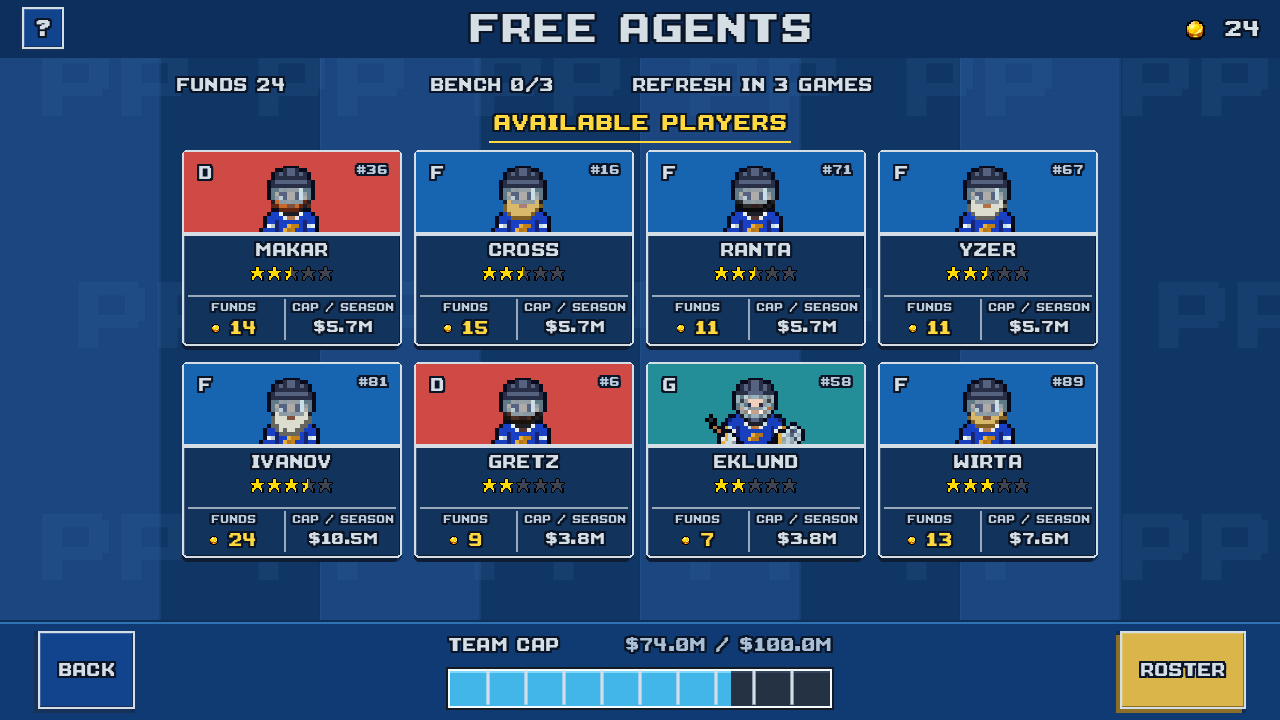
- Coin price
- The Club Funds cost to sign this player once. The detail screen calls it the open-market price. It is not a salary in millions.
- Cap / season
- The annual salary added to your team cap. A $7.6M hit means $7.6 million per season, not 7.6 Club Funds.
- Funds, bench, and team cap
- Funds is your wallet balance. Bench shows occupied reserve slots. Team cap shows committed annual salaries against the club's limit.
For ways to build that wallet balance, read the Club Funds guide.
Check the confirmation before paying
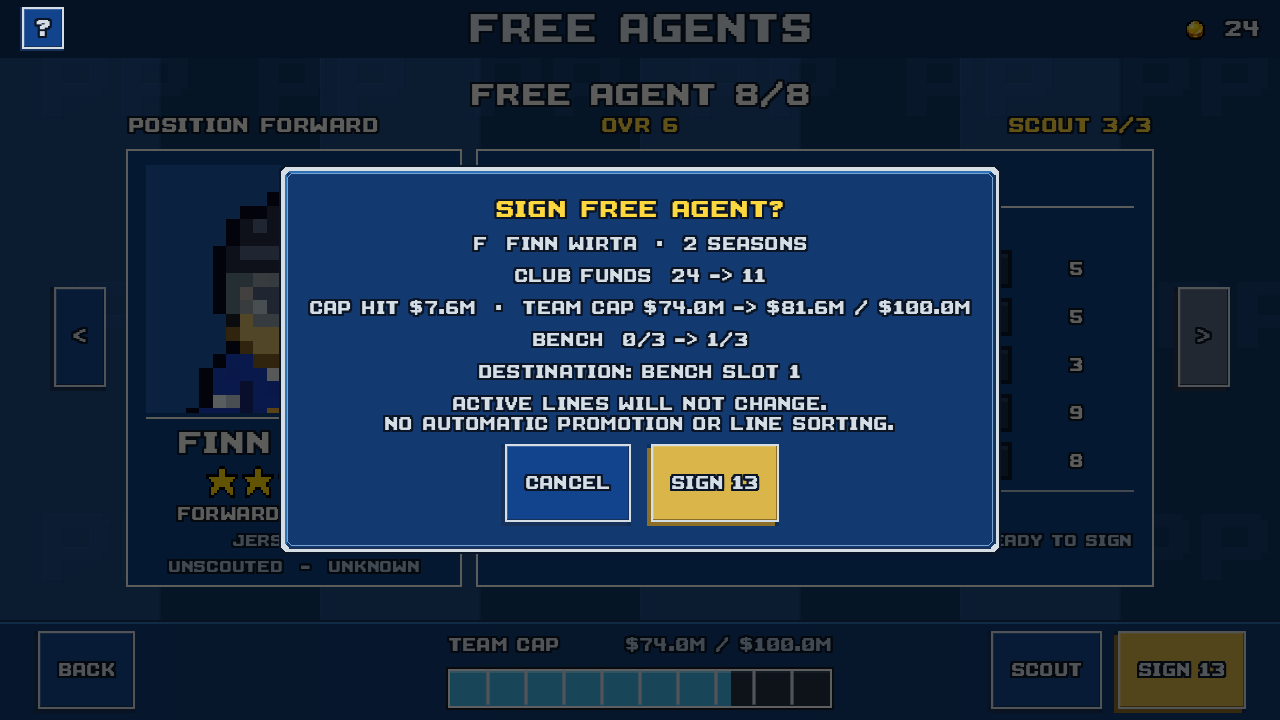
Choose Sign to review the offer. The confirmation shows the contract length in seasons, your Club Funds before and after, the player's cap hit, and the new team salary total. It also names the destination bench slot.
New market offers currently last two seasons. Their Club Funds prices vary within bands based on player quality. Use the price on the actual offer rather than treating one screenshot as a price list.
The salary depends on overall rating, contract length, and contract type. Standard, rookie, and depth contracts can have different annual rates.
SAMPLE FRANCHISE
Why one signing fits and another does not
Take a club with a $100.0M cap and a player with a 6 out of 10 overall rating. This example uses a standard two-season contract at $7.6M per season and a chosen signing cost of 12 Club Funds.
Every roster total and funds balance here is an example. The salary follows the current game rules. The 12 Club Funds price is a sample within this player tier, not a quote for every player. Assume the bench has room and the draft is complete.
A standard player contract
- Signing cost
- 12 Club Funds
- Annual cap hit
- $7.6M / season
Cap room
Fits exactly$7.6M available for a $7.6M annual hit
$92.4M + $7.6M = $100.0M. Exactly at the cap is allowed.
Club Funds
Enough funds12 available for a cost of 12
12 − 12 = 0 Club Funds left after paying the signing cost.
Both money checks pass. With an empty bench slot and no pending draft, this example fits.
This is a website illustration. It does not read or change your save.
| Example | Annual salary check | Club Funds check | Decision |
|---|---|---|---|
| Exactly enough | $92.4M + $7.6M = $100.0M. Exactly at the cap is allowed. | 12 − 12 = 0 Club Funds left after paying the signing cost. | Both money checks pass. With an empty bench slot and no pending draft, this example fits. |
| Short on Club Funds | $92.4M + $7.6M = $100.0M. Exactly at the cap is allowed. | You have 11 Club Funds and need 12. You are 1 short of the signing cost. | Club Funds block this signing. Enough cap room cannot pay the signing cost. |
| Short on cap room | $92.5M + $7.6M = $100.1M. That is $0.1M over the cap. | 12 − 12 = 0 Club Funds left after paying the signing cost. | The cap blocks this signing. Enough Club Funds cannot make up for missing cap room. |
What a different term changes
A standard one-season contract uses the full salary rate. Two seasons use 95% of that rate. Three seasons use 90%. The game rounds the result to the nearest $0.1M.
For the same example player, a longer term lowers the annual hit. It does not turn the whole contract into a single cap charge. Future annual salary reviews can still raise it.
| Term | Annual hit | Cap result |
|---|---|---|
| 1 season | $8.0M | Blocked by $0.4M |
| 2 seasons | $7.6M | Exactly at the cap |
| 3 seasons | $7.2M | $0.4M room left |
KEEPING A PLAYER
Renew the salary commitment
Expiring player contracts appear in the offseason contract review before the draft. Choose Re-sign to inspect the offered term and salary, then Confirm Re-sign to keep the player. Choose Let Go to release them. If you advance past contract review with a player still unsigned, that player is let go.
PLAYER EXTENSION
0 Club Funds
No second signing fee
The current build charges no Club Funds for a player extension. The new annual salary still has to pass the renewal cap check.
Replace the old hit with the new one. Do not add both salaries.
One, two, or three seasons
The game supports all three lengths. Age sets a preferred renewal term: three seasons through age 26, two at ages 27 to 32, and one from age 33. The game can adjust that term to spread contract expirations across seasons. Read the offer shown for your player.
Renewals normally use the player's current overall rating and the offered standard contract term. A player who has reached all of their personal attribute ceilings keeps their current annual hit when renewing.
If your club is already over the cap: a renewal is still allowed when it keeps or lowers the existing salary total. An increase must fit under the cap. This exception applies to renewals, not a new free agent signing.
| Current team salaries, including this player | $94.0M |
|---|---|
| Remove this player's old annual hit | −$6.0M |
| Add the offered annual hit | +$7.6M |
| New team salary total | $95.6M |
| Decision | The renewal fits, with $4.4M of cap room left. The Club Funds balance does not change. |
Once contracts are settled, use the drafting and scouting guide for the rookie selection step.
AT THE END OF A SEASON
A longer contract can still get a raise
Annual salary reviews apply to active players and reserves. A player gets a raise when their attributes have improved enough to move them into a higher salary tier. An improvement within the same tier does not automatically raise the salary. An active contract does not become cheaper because the player declines.
The starting cap is $100.0M. Completing a full season adds $5.0M to the limit, up to $150.0M. Salary raises can use some of that extra room, so check the new total in the offseason review.
See player development for how players gain attributes.
AFTER THE SIGNING
Your new player joins the bench
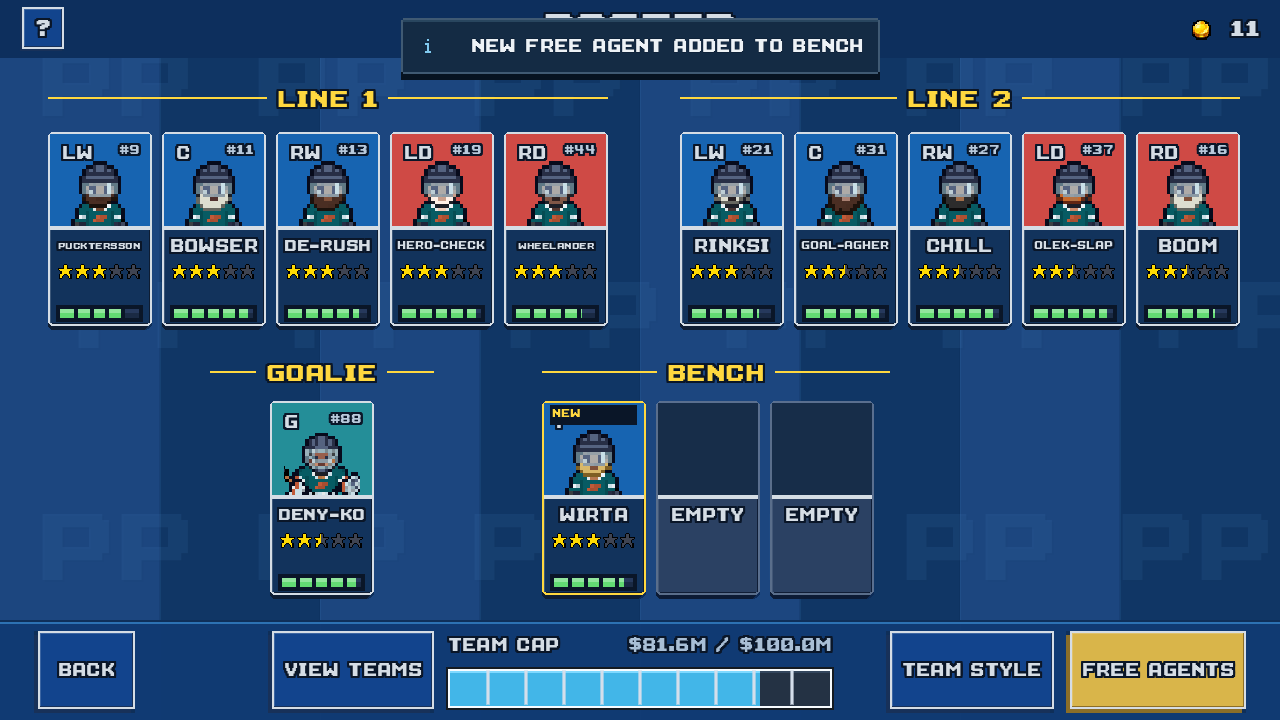
A free agent fills an empty reserve bench slot. Signing does not replace someone in your active lineup. Choose View Roster after signing to find the new player, then swap them into a matching lineup position when you want to use them.
Bench players count toward the cap too. Moving a player from the lineup to the bench does not remove their salary.
Use the roster and lineups guide to make the swap.
Checked against the development build on October 29, 2026. Screens show a sample franchise. Game rules and UI may change before release.
Release and testing
PixelPuck is in development for iPhone. There is no public App Store release date yet. You can email the developer about future testing opportunities. Android is planned, with no release date announced.
Email about testingOpens your email app.